
Bavarian Royal Order of Saint Hubert https://asiamedals.info/threads/bavarian-royal-order-of-saint-hubert-of-marshal-joachim-murat.30481/.
Prussian Black Eagle Order https://asiamedals.info/threads/prussian-black-eagle-order-of-marshal-joachim-murat.30482/.
Saxon Order of the Rue Crown https://asiamedals.info/threads/saxon-order-of-the-rue-crown-of-marshal-joachim-murat.30486/.
Order of the Crown of Westphalia https://asiamedals.info/threads/order-of-the-crown-of-westphalia-of-marshal-joachim-murat.30487/.
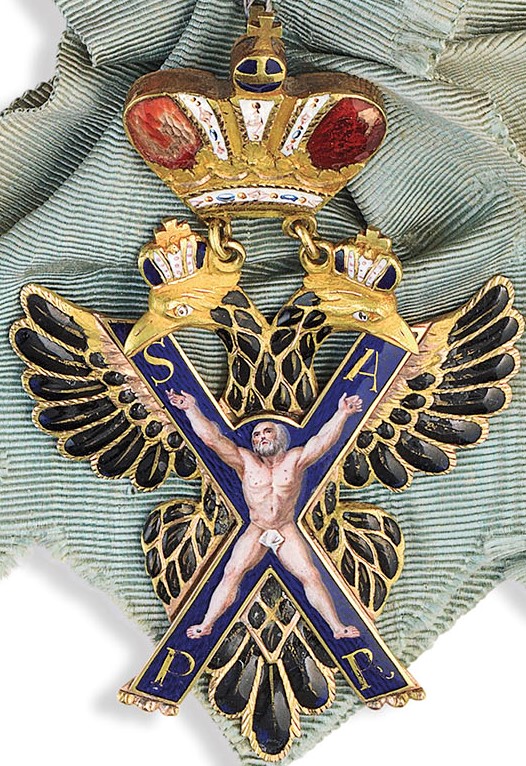
Gold, enamel.
Height 91 mm.
Prussian Black Eagle Order https://asiamedals.info/threads/prussian-black-eagle-order-of-marshal-joachim-murat.30482/.
Saxon Order of the Rue Crown https://asiamedals.info/threads/saxon-order-of-the-rue-crown-of-marshal-joachim-murat.30486/.
Order of the Crown of Westphalia https://asiamedals.info/threads/order-of-the-crown-of-westphalia-of-marshal-joachim-murat.30487/.
Gold, enamel.
Height 91 mm.
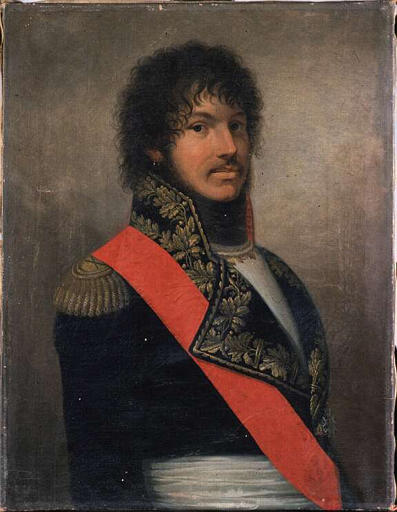
Marshal of the Empire, Admiral of France, Grand Duke of Berg and future King of Naples was awarded with this badge at Tilsit on July 3, 1807.
Joachim Murat (Gioacchino Murat; 25 March 1767 – 13 October 1815) was a French Army officer and statesman who served during the French Revolutionary and Napoleonic Wars. Under the French Empire he received the military titles of Marshal of the Empire and Admiral of France. He was the first Prince Murat,Grand Duke of Berg from 1806 to 1808, and King of Naples as Joachim-Napoleon from 1808 to 1815.
Born in Labastide-Fortunière in southwestern France, Murat briefly pursued a vocation in the clergy before enlisting in a cavalry regiment upon the outbreak of the French Revolution. Murat distinguished himself under the command of General Napoleon Bonaparte on 13 Vendémiaire (1795), when he seized a group of large cannons and was instrumental in suppressing the royalist insurrection in Paris. He became Napoleon's aide-de-camp and commanded the cavalry during the French campaigns in Italy and Egypt. Murat played a pivotal role in the Coup of 18 Brumaire (1799), which brought Napoleon to political power. In 1800 he married Caroline Bonaparte, thus becoming a brother-in-law to Napoleon.
Murat was named a Marshal of the Empire on the proclamation of the French Empire. He took part in various battles including those of Ulm, Austerlitz, Jena and Eylau, where he led a famous massed cavalry charge against the Russians. In 1806, Murat was appointed Grand Duke of Berg, a title he held until 1808 when he was named King of Naples. He continued to serve Napoleon during his Russian and German campaigns but abandoned the Grande Armée after the Battle of Leipzig to save his throne. In 1815, Murat launched the Neapolitan War against the Austrian Empire but was decisively defeated at Tolentino. He fled to Corsica and then made a last-ditch attempt to recover his throne, but was soon taken prisoner by King Ferdinand IV of Naples. He was tried for treason and sentenced to death by firing squad in Pizzo.
Joachim Murat (Gioacchino Murat; 25 March 1767 – 13 October 1815) was a French Army officer and statesman who served during the French Revolutionary and Napoleonic Wars. Under the French Empire he received the military titles of Marshal of the Empire and Admiral of France. He was the first Prince Murat,Grand Duke of Berg from 1806 to 1808, and King of Naples as Joachim-Napoleon from 1808 to 1815.
Born in Labastide-Fortunière in southwestern France, Murat briefly pursued a vocation in the clergy before enlisting in a cavalry regiment upon the outbreak of the French Revolution. Murat distinguished himself under the command of General Napoleon Bonaparte on 13 Vendémiaire (1795), when he seized a group of large cannons and was instrumental in suppressing the royalist insurrection in Paris. He became Napoleon's aide-de-camp and commanded the cavalry during the French campaigns in Italy and Egypt. Murat played a pivotal role in the Coup of 18 Brumaire (1799), which brought Napoleon to political power. In 1800 he married Caroline Bonaparte, thus becoming a brother-in-law to Napoleon.
Murat was named a Marshal of the Empire on the proclamation of the French Empire. He took part in various battles including those of Ulm, Austerlitz, Jena and Eylau, where he led a famous massed cavalry charge against the Russians. In 1806, Murat was appointed Grand Duke of Berg, a title he held until 1808 when he was named King of Naples. He continued to serve Napoleon during his Russian and German campaigns but abandoned the Grande Armée after the Battle of Leipzig to save his throne. In 1815, Murat launched the Neapolitan War against the Austrian Empire but was decisively defeated at Tolentino. He fled to Corsica and then made a last-ditch attempt to recover his throne, but was soon taken prisoner by King Ferdinand IV of Naples. He was tried for treason and sentenced to death by firing squad in Pizzo.