
Saint George Cross 4th class No. 871005 awarded in 1919 to Lieutenant E. C. White of 47th Squadron RAF

Interesting Civil War award to the member of 47th Squadron RAF for combats in Tsaritsyn in 1919.
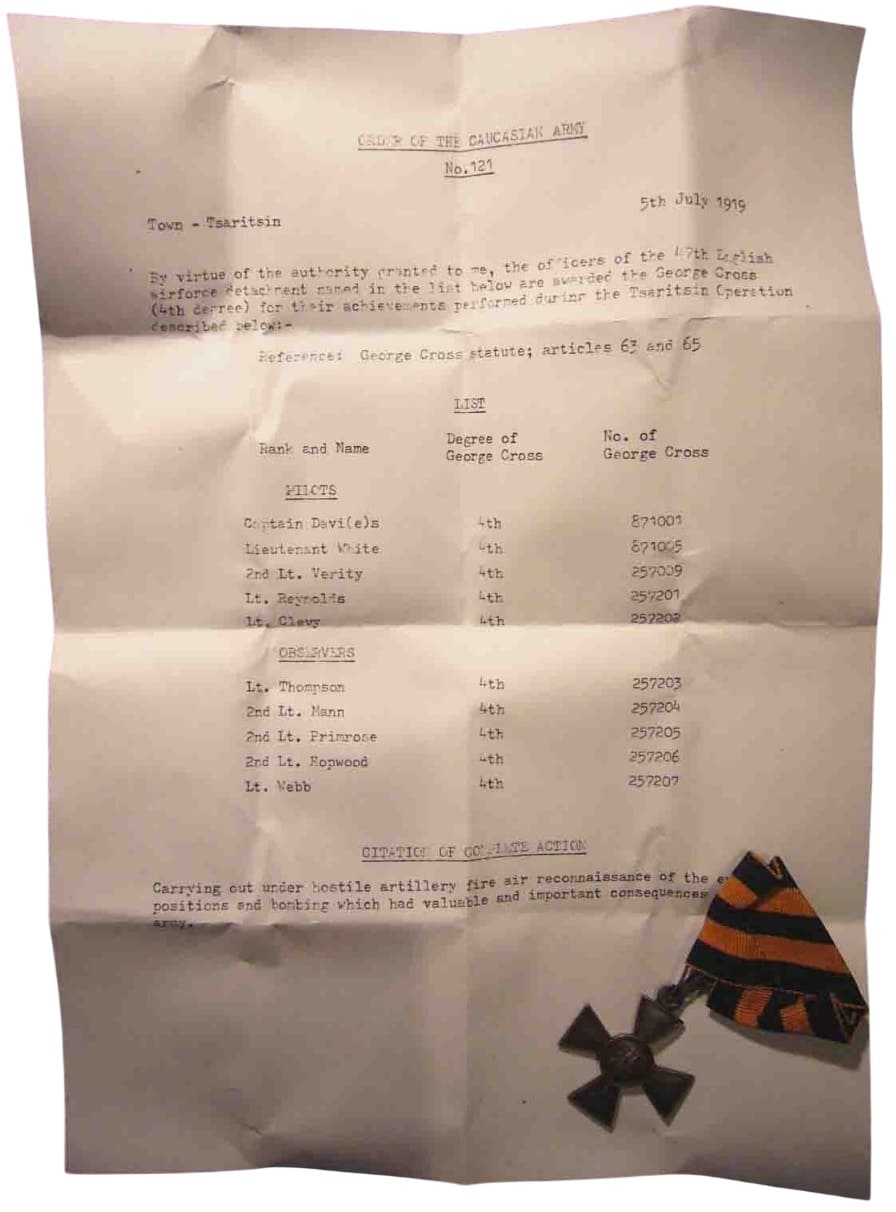
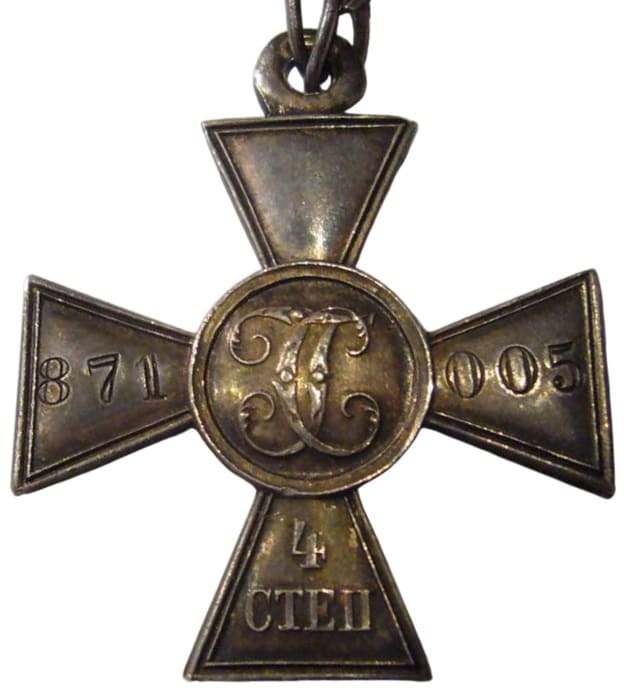
Saint George  cross 4th class No. 871005 awarded in 1919.jpg


Saint George cross 4th class No. 871005 awarded in 1919.jpg


Order of the Caucasian Army
No. 121
5th July 1919
Town — Tsaritsin​

By virtue of the authority granted to me, the officers of the 47th English airforce detachment named in the list below are awarded the george cross (4th degree) for their achievements performed during the tsaritsin operation described below:- reference: george cross statute: articles 63 and 65​
list

rank and name degree of george cross no. of george cross

pilots

captain davis(e)s 4th 871001
lieutenant white 4th 891005
2nd lt. verity 4th 257209
lt. reynolds 4th 257201
lt. clevy 4th 257202

observers

lt. thompson 4th 257203
2nd lt. mann 4th 257204
2nd lt. primrose 4th 257205
2nd lt. hopwood 4th 257206
lt. webb 4th 257207

Citation of combat action

carrying out under hostile artillery fire air reconnaissance of the enemy positions and bombing which had valuable and important consequences for the army.
 
Like most pilots of the South Russian Intervention, E. C. White began his military career flying over the Western Front or the Balkans during World War I. Following the 1918 Armistice, he volunteered for the South Russia RAF Mission.

He was assigned to "A" Flight of the No. 47 Squadron, flying the British Airco DH.9 (a two-seat light bomber powered by a Siddeley Puma engine). His primary role was a reconnaissance and bomber pilot, working closely with an observer/gunner, most notably Lieutenant Primrose.

E. C. White.jpg


The Tsaritsyn Campaign

Lieutenant White’s defining historical footprint occurred between June 27 and June 30, 1919, during General Pyotr Wrangel's third and final attempt to capture the heavily fortified Bolshevik stronghold of Tsaritsyn. His actions over these four days became a textbook example of multi-branch military cooperation.

• June 27 — The Strategic Reconnaissance Flight: The attack on Tsaritsyn relied heavily on a handful of newly arrived, British-supplied Mark V and Whippet tanks. To map out the assault, Lieutenant White took Major Ewen Cameron Bruce (the fiery, one-armed commander of the British Tank Corps detachment) up in his DH.9. White flew directly over the Bolshevik trench systems, allowing Major Bruce to spot critical gaps in the barbed-wire entanglements and heavy artillery placements.

• June 29 — Blinding the Enemy: As the White Russian army secretly massed its tanks and cavalry for the advance, a Bolshevik observation balloon went up, threatening to expose the hidden armored vehicles. Lieutenant White intercepted the balloon in his aircraft, braving heavy anti-aircraft fire to shoot it down, successfully hiding the tank concentration.

• June 30 — Ground Command and Flank Breakout: On the day Tsaritsyn fell, the advance stalled when the tanks ran out of fuel. When a sudden Bolshevik counter-attack threatened to overrun the exposed White Russian infantry flank, Lieutenant White—who was on the ground assisting the armored units—stepped up. He personally took command of three tanks, pushed them through heavy shellfire, and routed the enemy infantry.

Following the capture of Tsaritsyn, White continued flying bombing sorties, including high-altitude raids over the northern town of Kamyshin in July 1919. For his extraordinary dual service in the air and on the ground, he was awarded the Saint George Cross by General Wrangel’s provisional government.

After the British forces evacuated South Russia via Novorossiysk in early 1920, Lieutenant White returned to the UK.​
 
  • Tags
    saint george cross saint george cross 47th squadron raf saint george cross 4th class awarded in 1919 saint george cross 4th class no 871005 saint george cross 4th class to raf lieutenant георгивский крест гражданская война награды императорской россии ордена императорской россии
  • Top