The Shipping Command /
船舶司令部/ was an branch within the Imperial Japanese Army that commanded and controlled the maritime transport of troops and supplies during wartime. The Army shipping units, which were overseen by the Shipping Command, were commonly known as the "Akatsuki Units," derived from the unit designation "Akatsuki/
暁", which was assigned to each unit .
Akatsuki Unit No. 2940 was stationed in Ujina, Hiroshima City /広島市宇品1丁目凱旋館/. Led during the later stages of the war by Lieutenant General Bunroku Saeki /佐伯文郎/ the main tasks of the unit included controlling and managing all army maritime transport, logistics, shipping operations, training units and specialized watercraft units such as submersible transport education units and the Maru-Yu secret transport submarines.
The Type 3 submergence transport vehicle /三式潜航輸送艇, San-Shiki Senkō Yusōtei/ was a class of transport submarines built for the Imperial Japanese Army (IJA) during World War II. The IJA called them Maru Yu /マルゆ/.
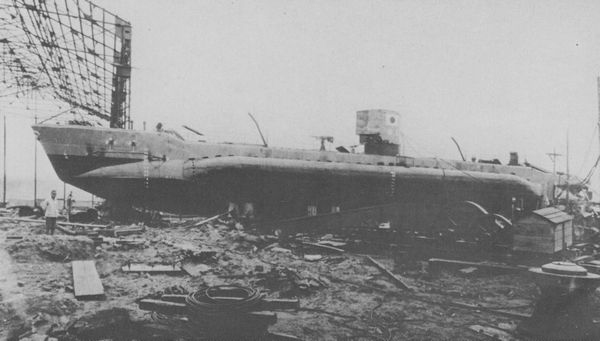
The six-month-long Guadalcanal campaign came to an end in early February 1943, when the last Imperial Japanese Army forces withdrew from Guadalcanal. Later that month, the IJA′s 10th Army Staff Headquarters, which was responsible for all IJA-operated ships, decided it would need to develop its own transport submarine - which it provisionally designated "transport boat" (Yuso-tei, abbreviated as Yu-tei) - with which to supply isolated IJA island garrisons in the Pacific Ocean. On 5 March 1943, the 10th Army Staff Headquarters began work with the 7th Army Research Institute to design such a submarine, find suitable manufacturers and shipyard space for the construction of a fleet of them, and complete 20 of them by end of 1943, followed by an additional 400 submarines in later years.