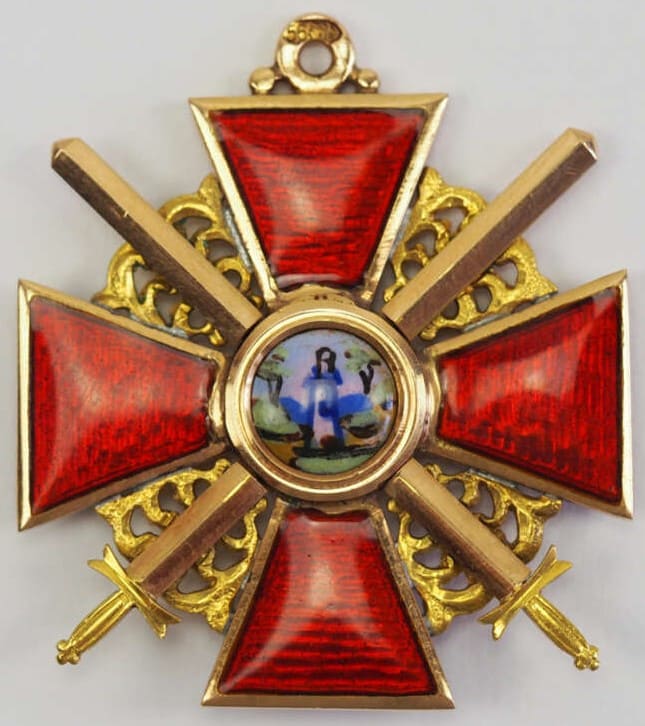
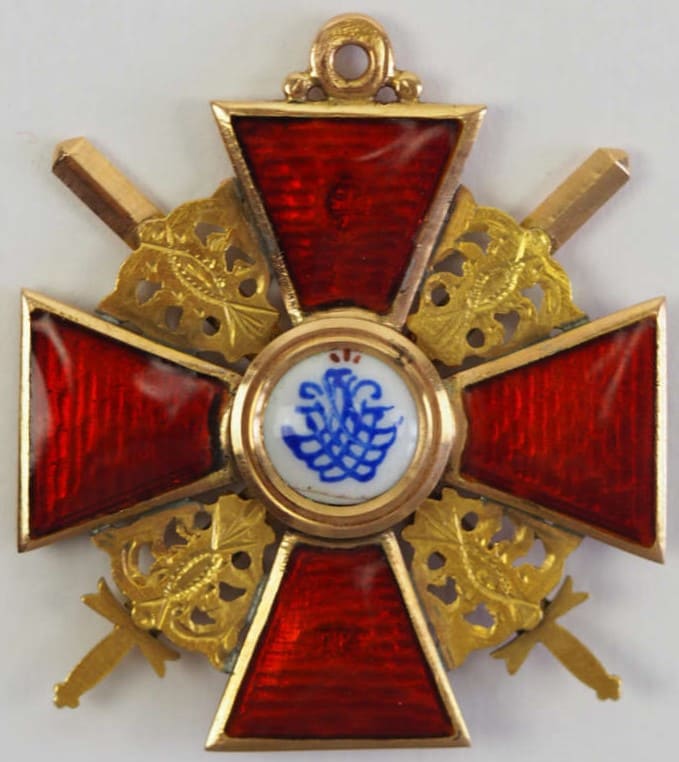
3rd class cross with swords from the 1882-1898 time period that was found inside the medal bar of Rear-Admiral John Claude Hamilton.
Gold, enamel.
Marked with a "double-headed imperial eagle" and partly readable maker's mark "A[K]" for Albert Keibel on reverse beneath the enamel, ring marked with St. Petersburg assay office gold hallmark "56+anchors" from 1882-1898 time period.
How this particular cross end up in the the Hamilton's medal bar remains a mystery.

John Claude Hamilton was born in Warrington, Lancashire on 14 July 1881, only son of Lieutenant-Colonel J. J. Hamilton of the King’s Regiment. Entering the Royal Navy as a Cadet in Britannia in July 1895, he first went to sea as a Midshipman in H.M.S. Eclipse in 1897-1900, flagship of the East Indies Squadron. Having then been advanced to Lieutenant, he served on the China Station before attending a gunnery course at Excellent in 1905-06.
Duly qualified, the outbreak of hostilities found him serving as Gunnery Officer of the battleship H.M.S. Superb in the Grand Fleet, in which capacity he was advanced to Commander in June 1915. One year later, at Jutland, Hamilton commanded the Superb’s 12-inch guns with skill and some success, claiming hits on the Wiesbaden and Derfflinger. For the Battle of Jutland he was awarded the Russian Order of St. Anne, 3rd Class, with swords (June 5, 1917, London Gazette).
Hamilton subsequently served in the battleship Neptune from June 1917 until June 1918 and ended the war as Assistant to the Director of Naval Ordnance. The 1920s witnessed him occupying several senior commands, among them the captaincy of the cruiser Durban on the China Station in 1924-27, and time as Flag-Captain to the Rear-Admiral of the 1st Battle Squadron in the Mediterranean, in the Barham . He retired on his advancement to Flag rank in October 1932.
The renewal of hostilities saw his return to uniform as a Commander of Convoys 2nd Class, R.N.R., in which rank he was appointed to Pembroke with the London Convoy Pool, but he transferred to Eaglet as C.O. of the Liverpool Convoy Pool in July 1940. And it was whilst in the performance of these duties on 30 December 1940, between Liverpool and a convoy lying off-shore, that he was killed when the M.V. Calcium , in which he was being conveyed, struck a mine and sank almost immediately, with large loss of life.
The Admiral, who was 60 and described in his Times obituary as "a fine rifle shot", has no known grave and is commemorated on the Liverpool Memorial.